Detailed information can be found on the external project website. Click here to go directly to the RIVERSteps project.
River: Thamirabarani
Name of city/settlements along the river: Tirunelveli / Palayamkottai Tamil Nadu South India
Rationale:
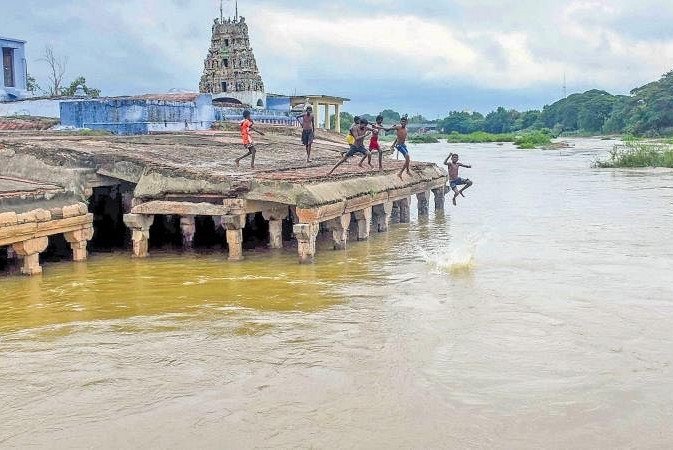
Inspired by the concept of Riverine Ethnic Identities (Maimunah 2022) we consider the riverine caste identities in the twin cities Tirunelveli and Palayamkottai along the river benches of the Thamirabarani in Tamil Nadu, South India. Riverine caste identities examine the relation different people maintain to the river and the land, as it shapes the way they see the world and react to it. The rhythm of the river ecosystem is closely linked to the mandapams along is benches – pillar halls carved out of stone. Activities such as bathing, collecting water, mooring the boat and fishing take place around the mandapam. Mandapams attached to temples are often a site of religious rituals or devotional concerts. Thus, the mandapam is an imaginary bridge between the land, the river and the cosmos symbolizing the relationship between the different people and the riverine ecosystem.
Methods:
We explore these riverine identities through storytelling, participatory mapping, transect walks to understand how the mandapam is used for what and by whom. We pool different forms of “knowledges” to articulate and visualize the sorrow, the hope and the vision for just riverine caste identities. Tackling the deeply entrenched notions of caste, class and gender in South India keeps us aware of the embodied relationships to the river and the mandapams as testimonies of centuries old attachment to the water. By allowing different and less heard stories in contrast to the mostly technical or upper caste Hindu-mainstream conversation about the river, our transdisciplinary research approach aims to discover embodied imaginaries of riverine caste identities around the mandapams and stone steps through a feminist political ecology lens (Harcourt & Nelson 2015). The emerging concept of water justice questions entrenched perceptions of neatly compartmentalized technocratic, ahistorical and apolitical approaches by recognizing naturecultures as the co-constitution of the human and the natural world.
Strategy:
With a transdisciplinary approach we aim to co-produce transformation knowledge on the river and its relation between citizens. While we approach the river biography and the mapping with a set of interdisciplinary methods, we aim to consider the river city as a boundary object to synthesize our findings with the experiences of different riveriners. This will take place especially during transdisciplinary workshops, which will allow us to create transdisciplinary moments (Lakamana forthcoming) of entrenched discourses opening up and new knowledges emerging. A series of three transdisciplinary events may be broken into smaller settings to create safe spaces to speak up.
We perceive resilience as a creative capacity to adjust to changing conditions, for example, like new weather patterns including an increasing likeliness of severe flooding due to climate change. However, we reject the idea sometimes implicitly inherent in some working definitions of resilience as the ability to return to a stable state. We perceive even the idea of a more just or sustainable situation as highly contested. Whether an evaluation from an ecological or social, political, or cultural perspective, the assessment of the outcome depends ultimately on the framing of the issue at stake, by whom this is done and whose knowledge counts (Nightinggale 2019). Thus, we embrace the notion of different resilience narratives and the need for deliberations about transformation goals as part and parcel of such a process.
We further underline the importance of a political take on resilience, considering existing enabling and constraining institutions. Exactly these institutions are the result of rule and norm making backed by entitlements and power to sanction deviators. While patriarchal power is embedded in the institutions of caste, class, gender and generation, they can be transformed. Avoiding the political and ahistorical take of resilience as return to an equilibrium, we argue for a nuanced attention to intersectional dimensions of what justice could mean for different subjectivities and positionalities. Working with different communities, we aim to elucidate situated meanings of water justice – regarding consumption, waste and the riverbody as a place.
To foster these communication processes, we aim to involve artists from the communities, preferably women or youth artists from different caste groups to articulate and visualize the sorrow, the hope and the vision for a just river relation and a resilient riverine identity.