














Following a resolution by the Faculty Council of the Faculty of Social and Educational Sciences, it was decided to award an honorary doctorate to the renowned Australian researcher, Professor Wendy Harcourt, in recognition of her outstanding academic achievements in the field of sociology. The scholar was honoured for establishing the research field of feminist political ecology and for her work on sustainable development. In her ceremonial lecture, she took the audience on a journey to the sea turtles of the Great Barrier Reef. Using these animals as an example, she showed how closely the coexistence of humans and other living beings is interwoven – and why, in the face of global crises, we need not only scientific analyses but also narratives that convey hope.
A particular moment marked Harcourt's lecture: in 2002, the researcher swam with sea turtles near Heron Island on the Australian Great Barrier Reef. She described this encounter as a "shimmering moment", a magical, shining moment. The experience embodies a perspective that has shaped Harcourt's scholarly work for many years: rather than viewing people and nature as separate, she places their manifold relationships at the centre.
With the honorary doctorate of the Faculty of Social and Educational Sciences, Wendy Harcourt is the second person and the first woman to receive this distinction. In his laudation, Dean Professor Oliver Hidalgo praised her services to broadening scholarly perspectives on ethical questions and gender equality. Harcourt has made a major contribution to ensuring that ecological crises are always considered in connection with societal power relations and social hierarchies.
Connections to the University of Passau
The laudators also highlighted Harcourt's long-standing connections to the University of Passau. Vice President Professor Harald Kosch honoured her as a "co-founder" of the international Master's programme in Development Studies, which she launched together with Passau's development sociologist Professor Martina Padmanabhan and the development economist Professor Michael Grimm. Since its introduction in 2015, the programme has brought students from more than 65 countries to Passau. "You are now also one of our Doctors," said Kosch, addressing Harcourt. "May your lecture inspire your students."
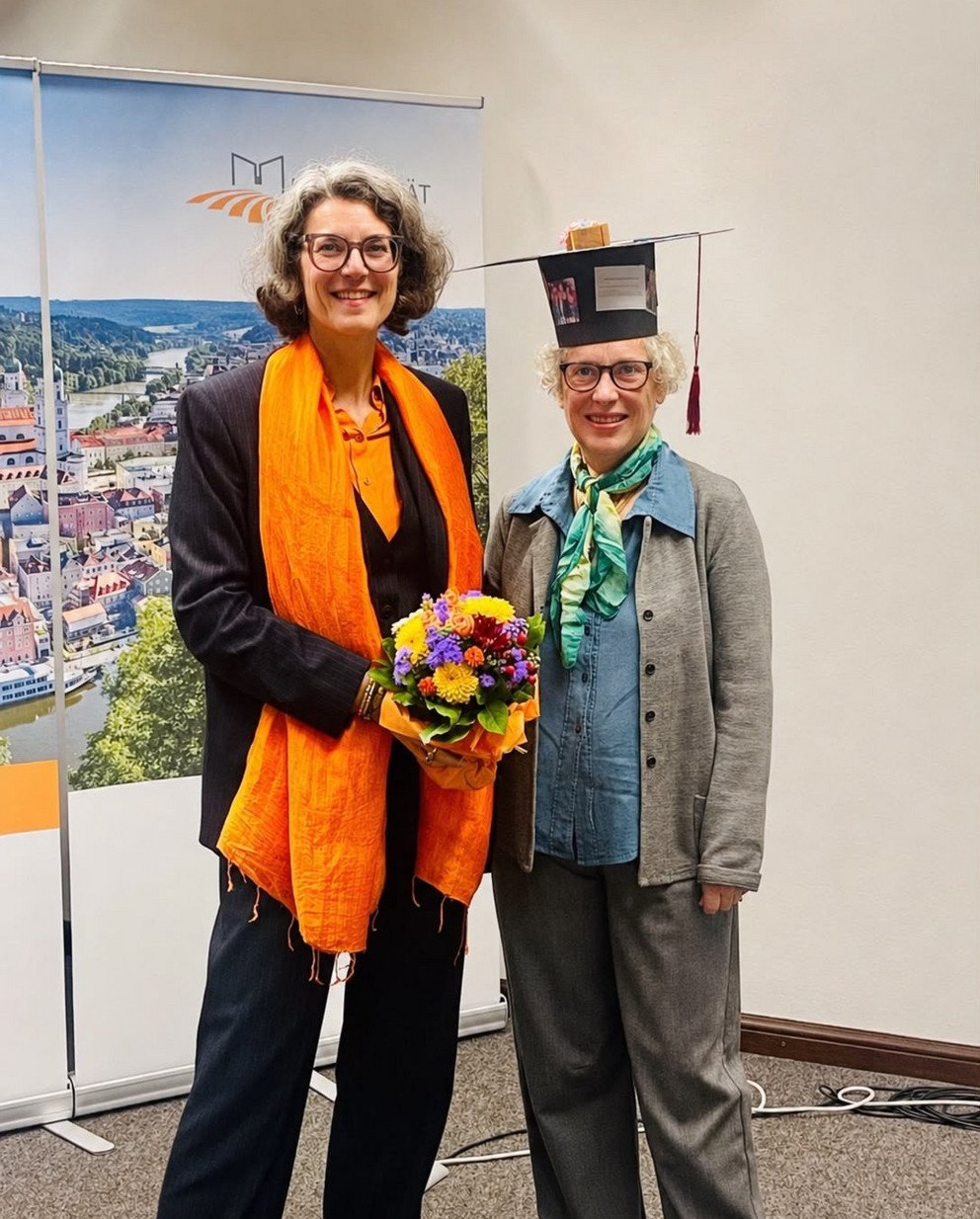
Professor Padmanabhan honoured Harcourt as a "pioneer in thinking through the manifold dilemmas of habitability " and as the founder of the field of "feminist political ecology". This field combines questions of ecological sustainability with the analysis of power relations and gender equality. It directs attention to those people and communities who are particularly affected by environmental change and social inequalities. As a symbolic gift, Professor Padmanabhan presented her with a specially designed doctoral cap depicting important milestones in Harcourt's scholarly career.
The holder of the Chair of Critical Development Studies in Southeast Asia at the University of Passau had a further surprise in store: two video messages from former doctoral candidates of the European network "WEGO: Wellbeing, Ecology, Gender and cOmmunity", which links Professor Padmanabhan and Professor Harcourt. It is the first European research network for "feminist political ecology". It was funded as an Innovative Training Network under the Marie Skłodowska-Curie Actions (MSCA) as part of the European Union's Horizon 2020 programme (grant number 764908).
Dr Siti Maimunah sent greetings from Indonesia. Her teaching, she said, is inspired by Harcourt's research. As proof, she held a book up to the camera with the title "Our Weapon is the Traditional Ritual". It shows how indigenous women fight against environmental destruction, mining and land grabbing. Their means are ceremonies, mantras and cultural practices. The second message came from the United Kingdom, from Dr Enid Still, who now conducts research and teaches at the University of Greenwich in Britain.
In addition to the former doctoral candidates, Professor Harcourt also inspires researchers at the University of Passau. Harcourt's lecture marks the opening of an English-language lecture series in the winter semester 2026/27 on the topic of Habitability in the Global South. The researchers ask how habitability is negotiated in a world of escalating crises in which humans, animals, plants and other life forms are intertwined with one another. The lecture series forms part of the University of Passau’s emerging research area "Sustainable Transformation”.
About Professor Wendy Harcourt
Professor Wendy Harcourt is a renowned Australian ecologist and feminist scholar. Until her retirement in April 2026, she held the position of Professor of Gender, Diversity and Sustainable Development at the International Institute of Social Studies (ISS) of Erasmus University Rotterdam for 14 years. For 23 years, she headed the Society for International Development in Rome. In March 2026, she delivered her farewell lecture at the ISS in The Hague, entitled "Connecting with Care: Pedagogies for transformation", on the ethical and pedagogical questions raised by the concept of care. Shortly beforehand, she published her monograph "Conundrums of Care: Feminist Entanglements in Critical Development Studies". She lives in Rome as an academic author.
Further information:
- Report on the lecture by Professor Wendy Harcourt in the Digital Research Magazine: https://www.digital.uni-passau.de/en/beitraege/2026/habitability-research-wendy-harcourt
- Programme for the English-language lecture series on habitability in the Global South during the 2026/2027 winter semester https://www.uni-passau.de/nachhaltigkeit/lehre/ringvorlesung-nachhaltigkeit/ringvorlesung-habitability-ws-2026/27
This text was machine-translated from German.