

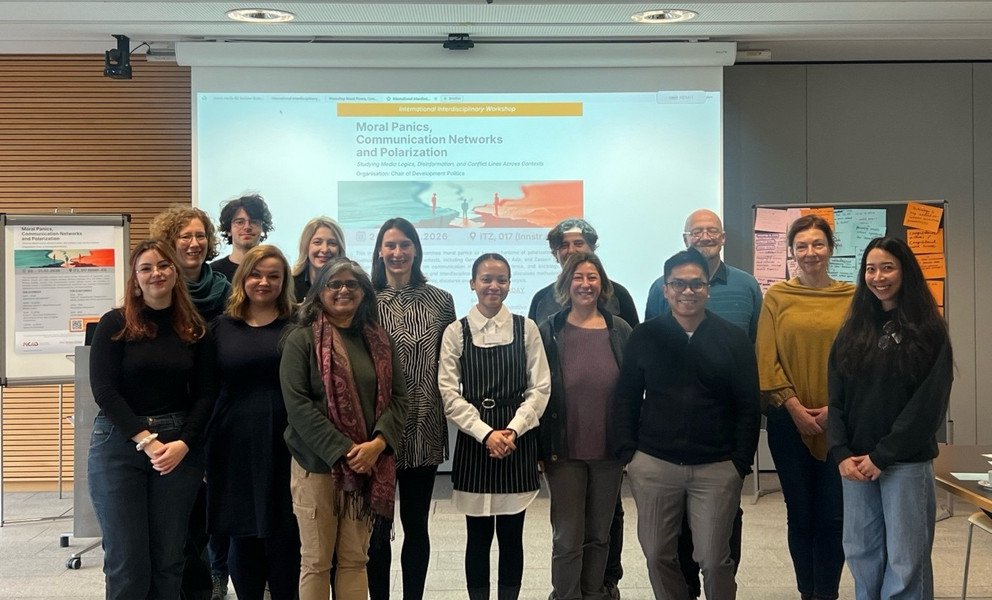
Im Workshop „Moral Panics, Communication Networks and Polarization“ hatten wir zwei Tage intensiver Diskussionen und aufschlussreichen Austauschs mit Forscher:innen aus verschiedenen Regionen und unterschiedlichen akademischen Hintergründen.
Was diesen Workshop besonders wertvoll machte, war der interdisziplinäre Austausch. Die Zusammenführung von Perspektiven aus u.a. der Kommunikationswissenschaft, der Politikwissenschaft und der Soziologie zeigte erneut, dass Polarisierung kein eindimensionales Phänomen ist. Vielmehr entfaltet sie sich im Zusammenspiel von Kommunikationsnetzwerken, politischer Mobilisierung, medialen Deutungsmustern und umfassenderen gesellschaftlichen Dynamiken.
Die Diskussionen waren kritisch, vergleichend und methodisch vielseitig. Die Vielfalt regionaler Expertise – mit Perspektiven aus Deutschland, Georgien, der Türkei, Polen, Malaysia, Thailand sowie weiteren Kontexten in Europa und Südostasien – hinterfragte bestehende Annahmen und schärfte die analytischen Herangehensweisen.
Die Gespräche mit allen Teilnehmenden machten deutlich, wie unverzichtbar Multiperspektivität für die Erforschung moralischer Paniken und gegenwärtiger Polarisierungsprozesse ist. Der Workshop brachte nicht nur unterschiedliche Disziplinen miteinander ins Gespräch, sondern schuf einen gemeinsamen Raum für kritische Reflexion, neue Kooperationen und innovative Forschungsimpulse.
Diese vielfältige Gruppe von Wissenschaftler:innen trug zu einem facettenreichen interdisziplinären und komparativem Austausch über Regionen und methodische Ansätze hinweg bei:
Laura Behrmann – Universität Wuppertal
David Borukhson – FZI Forschungszentrum Informatik / Karlsruhe Institute of Technology
Salome Kandelaki – New Vision University
Marta Kozlowska – Universität der Bundeswehr München
Min Htin Kyaw Lat – Universität Passau
Timo Lenk – TU Dortmund
Boris Nieswand – Universität Tübingen
Barbara Pasamonik – Maria Grzegorzewska University
Bancharat Polpila – Universität Passau
Melanie Radue – Universität Passau
Wolfram Schaffar – Universität Passau
Ülker Sözen – IRGAC, Universität Passau
Gayathry Venkiteswaran – University of Nottingham Malaysia
Valéria Zimba – Universität Passau

 Diese Seite teilen
