

Workshops
Moral Panics, Communication Networks and Polarization

About the Workshop
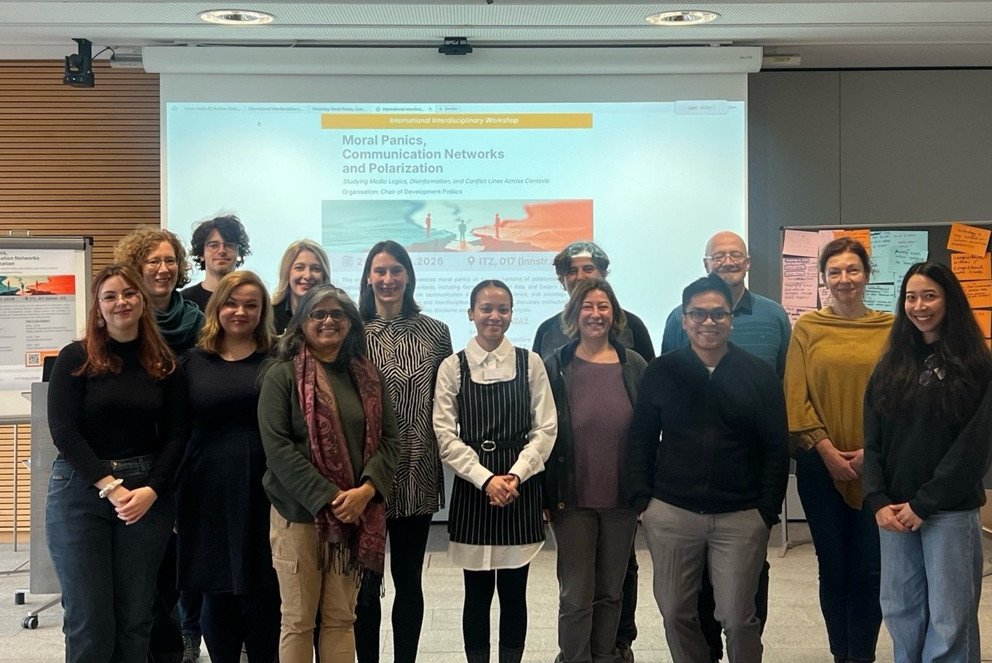
Over two days in February (20–21 February, 2026), Dr. Melanie Radue, together with the Chair of Development Politics, convened scholars at the University of Passau for the International Interdisciplinary Workshop “Moral Panics, Communication Networks and Polarization.” The workshop was jointly funded by PICAIS and the Fritz-Thyssen-Stiftung.
What was Discussed?
At the workshop „Moral Panics, Communication Networks and Polarization” we had two days of intense discussions and insightful exchange with scholars from different regions and from different academic backgrounds.
What made this workshop truly valuable was its genuine interdisciplinary exchange. Bringing together perspectives from, e.g. communication studies, political science, and sociology showed once again that polarization is not a single-dimensional phenomenon — it unfolds through communication networks, political mobilization, media framing, and broader social dynamics.
The discussions were critical, comparative, and methodologically rich. The diversity of regional expertise — spanning Germany, Georgia, Turkey, Poland, Malaysia, Thailand and other contexts in Europe and Southeast Asia — challenged assumptions and sharpened analytical approaches.
The conversations with all participants highlighted how essential multi-perspectivity is when studying moral panics and contemporary polarization. The workshop did not just connect disciplines — it created a shared space for critical reflection, new collaborations, and fresh research ideas moving forward.
Participants and Program
This diverse group of scholars contributed to a rich interdisciplinary and comparative exchange across regions and methodological approaches:
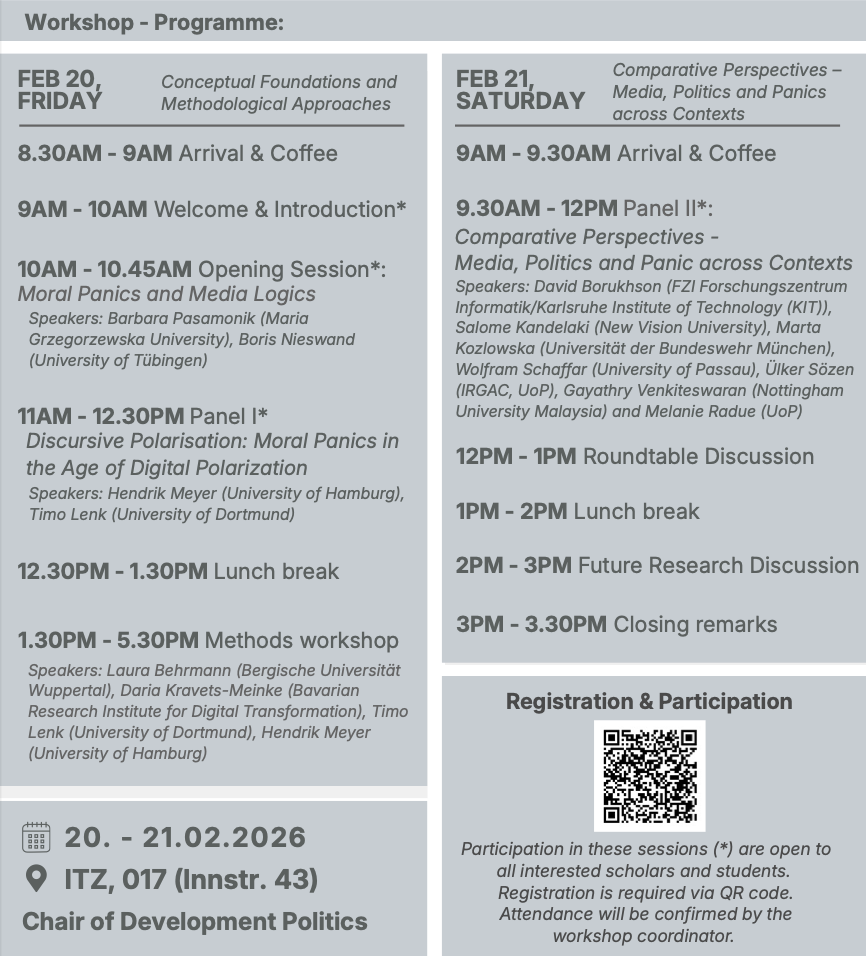
Laura Behrmann – University of Wuppertal, David Borukhson – FZI Forschungszentrum Informatik / Karlsruhe Institute of Technology, Salome Kandelaki – New Vision University, Marta Kozlowska – Universität der Bundeswehr München, Min Htin Kyaw Lat – University of Passau, Timo Lenk – TU Dortmund University, Boris Nieswand – University of Tübingen, Barbara Pasamonik – Maria Grzegorzewska University, BancharatPolpila– University of Passau, Melanie Radue – University of Passau, Wolfram Schaffar – University of Passau, Ülker Sözen – IRGAC, University of Passau, Gayathry Venkiteswaran – University of Nottingham Malaysia, Valéria Zimba – University of Passau
Media, Moral Panics and Identities: Polarisation and Populism in Malaysia and Germany
About the Workshop
Date: 09 July 2025
This workshop explores the dynamics of polarised media discourses and their political instrumentalisation in both Germany and Malaysia, with a particular focus on the Malay-Muslim experience in Malaysia. Drawing on comparativeresearch, the workshop examines how localised incidents—such as the “Berlin Public Pool Riots” in Germany and the “KK Mart Halal Mockery” in Malaysia—are transformed by media and political actors into broader narratives of cultural threat and moral panic.
The session opens with an introduction into the comparative project of moral panics, polarisation and the media in Malaysia and Germany, where conservative and far-right actors leverage incidents involving migration and public order to reinforce xenophobic narratives and normalise extremist positions. Media coverage in Germany and Malaysia is shown to amplify fears and legitimize restrictive policies, contributing to increased social division and the electoral success of right-wing populists.
The main focus then shifts to the Malaysian context, where incidents like the KK Mart sock scandal are used by political elites to intensify ethnic and religious divides, often portraying non-Malay minorities as disrespectful or threatening to national values. The workshop situates these developments within Malaysia’s historical and structural context, including the legacy of May 13, 1969, and the enduring significance of the “Three Rs” (race, religion, royalty) in contemporary politics and media. We will discuss the relevance of the concept of moral panics to understand polarization of modern societies.
Through empirical research, historical reflection, and discussion, the workshop aims to foster a nuanced understanding of how media logics, political rhetoric, and institutional frameworks shape identity politics and social cohesion in both countries.
Participants and Program
Participants:
Zaharom Nain - Professor and Directorof the Centre for the Study of Communications and Culture, and Professor of Media and Communication Studies at the University of Nottingham Malaysia Campus (UNMC) ; AzmylYusof - Senior Lecturer | Artist and Researcher at School of Film & Performing Arts, Faculty of Arts & Social Sciences, Sunway University ; TUNG Wan Qing - Lecturer at New Era University College - Department of Media Studies ; Gayathry Venkiteswaran - Assitant Professor for media and communication studies at the Nottingham University Malaysia and member of the Founding Board of the Malaysian Media Council ; Melanie Radue - Research Fellow at the University of Passau ; Irfan Naveen - Media Monitoring Programme Officer at the Centre for Independent Journalism (CIJ) ; Dineshwara Naidu- Manager of CIJs monitoring of hate speech at the Centre for Independent Journalism (CIJ)
Program:
Workshop Timeline:
09:30–10.00 | Welcome & Introduction
10:00–11:00 | Opening Session with project introduction and discussion
Researchers:
- Melanie Radue
- Gayathry Venkiteswaran
11:00–11.15| Short Break
11.15–14.15| Interventions (10-15 minutes Input + Discussion)
Speakers:
- Zaharom Nain (Nottingham University Malaysia): The 3 R´s, media and polarization
- AzmylYunor (Sunway University Malaysia): The concept of Moral Panics
- Tung Wan Qing (Sunway University Malaysia): May 13 narratives
- Dineshwara Naidu and Irfan Naveen(CIJ, Malaysia): CIJs monitoring of hate speech
14.15-15.00| Lunch
15.00-17.00 | Meeting with CIJ stuff to discuss setup of the new media council

 Share this page
